
-

Minimize downtime
-

Mitigate risk

-
Get peace of mind

Business Continuity Plan Services
-
Business Continuity Planning
Stay operational during and after a natural disaster, cyberattack or other disruption

-
Data Backup and Recovery
Protect critical data and ensure swift recovery, reducing downtime and potential financial loss

-
Risk Assessment and Mitigation
We identify vulnerabilities and implement strategies to minimize risks

-
Remote Work Solutions
Enable your team to work securely from anywhere, ensuring business continuity even in remote environments
-
Disaster Recovery Planning
We create tailored recovery plans to get your business back on its feet fast

-
Cloud Services
Be more flexible and efficient with cloud solutions that provide scalable and secure data storage and accessibility
-
Incident Response
Our rapid response and containment strategies mitigate the impact of security incidents and prevent further damage

Are Business Continuity Gaps Keeping You Up at Night?
- Are you losing sleep over the possibility of unexpected disruptions derailing your business operations?
- Do you worry about the potential financial loss and reputation damage that could result from inadequate business continuity planning?
- Does the uncertainty of doing business today feel overwhelming?
If you answered yes to any of these questions, SynchroNet can ease your worries.
Business Continuity, Done The Right Way
We understand that navigating the intricacies of business continuity planning can be overwhelming and stressful. At SynchroNet, we're here to guide you through the process, offering expert solutions and peace of mind, ensuring your business is cyber-resilient and thriving, no matter what challenges arise.
Partner with us for a more secure digital future.
-
Repeat IT issues cut by 60 percent after 3 - 6 months
-
60-day “no questions asked” refund policy
-
80 + businesses trust SynchroNet for IT services

SynchroNet Customers Say

































The SynchroNet Way
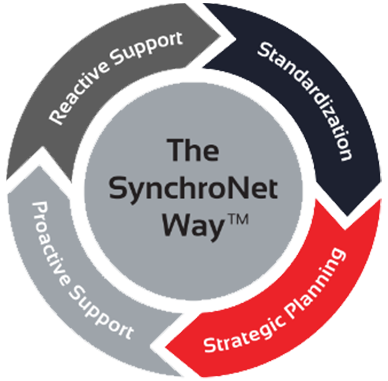
Want to move your business IT from the wild, wild West to an island of serenity? We get it, and we’ve helped transform everyday work life for hundreds of clients using The SynchroNet Way.
With our approach you get:
-
Standardization and a 100-point Best Practices checklist assigned to a dedicated network administrator.
-
Strategic planning at an executive level with a dedicated vCIO that keeps you on track for the long run.
-
Proactive support that monitors and protects your systems around the clock.
-
Reactive support from our friendly and caring customer support team who are always on the lookout for repeat issues.

Don’t
Put Business Continuity Planning
On The Back Burner

What's at stake without a reliable business continuity planning partner? Neglecting business continuity planning can put your business at risk of:
- Operational Disruption and Financial Loss: Without a well-thought-out business continuity plan, unexpected disruptions can lead to operational downtime, financial loss, and loss of productivity, resulting in an inefficient use of your valuable time and resources.
- Reputation Damage: Extended disruptions or service outages can harm your business's reputation and customer trust, which can take years to rebuild.
- Competitive Disadvantage: Businesses that lack a solid continuity plan risk falling behind competitors who can quickly adapt to unforeseen challenges, potentially impacting your market position and growth prospects.
Don't underestimate the potential risks. Let SynchroNet be your guide in embracing a robust business continuity plan to protect your business from these threats and ensure you remain agile, secure, and competitive in the face of adversity.



FAQs
A business continuity plan (BCP) is a strategy that maintains operations during and after disruptions through structured recovery planning and resilience measures. Business Continuity Plan Services rely on infrastructure such as cloud virtualization, redundant internet connectivity and secure data backup systems to keep systems functional during outages and disruptions.
Core business continuity infrastructure includes:
- Cloud virtualization (IaaS): Virtual servers allow workloads to be restored in a secure Infrastructure as a Service (IaaS) environment when physical systems fail.
- Redundant connectivity: Secondary internet circuits and automatic failover appliances maintain access during ISP outages or local infrastructure disruptions.
- Immutable data backups: Write-protected backups and off-site replication prevent ransomware from altering or deleting recovery data.
- Failover systems: If primary servers fail, workloads automatically shift to secondary environments to maintain uptime and meet Recovery Time Objectives (RTOs).
- Disaster recovery readiness: Pre-configured recovery environments reduce downtime by eliminating delays associated with rebuilding servers and applications manually.
To learn more, visit our Business Continuity Plan Services page or read this related FAQ: What is the difference between a backup plan and a business continuity plan?
A backup plan stores copies of data for restoration after data loss. A business continuity plan (BCP) defines how systems, users and infrastructure continue operating during and after a disruption. Backup strategies focus on recovering files, while business continuity planning restores critical operations within defined recovery time objectives.
Key differences between backup plans and business continuity plans include:
- Scope of recovery: Backups restore data only, while business continuity plans restore systems, applications and business operations.
- Operational continuity: If only backups exist, downtime continues until infrastructure is rebuilt, delaying productivity.
- Recovery objectives: Business continuity planning defines Recovery Time Objectives (RTO) to restore operations within defined timeframes, often within hours.
- System readiness: Backup systems require manual restoration, while BCP environments often use pre-built recovery infrastructure.
- Business impact: Backup failures typically affect data recovery, while BCP failures impact entire business operations and revenue flow.
To learn more, visit our Business Continuity Plan Services page or read this related FAQ: What is a business continuity plan and what infrastructure is required?
Business Continuity Plan Services ensure business continuity by maintaining operations during and after disruptions through structured recovery planning and resilience strategies. These services align systems, staff and infrastructure to support uninterrupted operations during outages, cyber incidents and disaster events.
Cloud-driven continuity capabilities include:
- Geo-redundant infrastructure: If a regional data center fails, workloads shift to another location using off-site replication and synchronized data storage to maintain availability.
- Rapid failover environments: If primary systems go offline, virtual machines are deployed through Infrastructure as a Service (IaaS) platforms to restore operations within defined Recovery Time Objectives (RTO).
- Scalable recovery capacity: Cloud environments allocate compute and storage resources during recovery events to maintain production workloads without performance degradation.
- Remote accessibility: If an office becomes unavailable, identity-based access controls and encrypted connections enable secure system access from any location with internet connectivity.
- Disaster isolation: If ransomware impacts local endpoints, immutable backups and AES-256 encrypted cloud storage prevent data corruption and ensure recoverability.
To learn more, visit our Business Continuity Plan Services page or read this related FAQ: What is the difference between a backup plan and a business continuity plan?
To create a business continuity plan, start by identifying key business functions and potential risks. Develop strategies to maintain these functions during disruptions and establish communication and recovery protocols. Collaborating with a trusted partner like SynchroNet can simplify the process and ensure your plan is comprehensive and effective.
To learn more, visit our Business Continuity Plan Services page or read this related FAQ: What is the difference between a backup plan and a business continuity plan?
Yes, small businesses can benefit significantly from business continuity and disaster recovery services. Unexpected disruptions can impact businesses of all sizes, and having a solid BCDR strategy in place helps minimize the risks associated with downtime, financial loss, and reputation damage. It can be tailored to meet the specific needs and budget of small businesses.
To learn more, visit our Business Continuity Plan Services page or read this related FAQ: What is the difference between a backup plan and a business continuity plan?
A business continuity plan should be reviewed and updated regularly to remain effective. As business dynamics change, new risks emerge, and technologies evolve, it’s recommended to review and update the plan at least annually. Regular testing and practice runs can also help ensure the plan’s effectiveness.
To learn more, visit our Business Continuity Plan Services page or read this related FAQ: What is the difference between a backup plan and a business continuity plan?