-

Get around-the-clock monitoring
-

Count on advanced EDR/XDR solutions

-
Fortify with a proactive security process

Our Ransomware Protection Services
-
Continuous Threat Monitoring
Our security operations center (SOC) provides real-time monitoring to detect and respond to threats

-
EDR/XDR Implementation
Rely on advanced endpoint detection and response (EDR) and extended detection and response (XDR) solutions

-
Ransomware Prevention Strategies
Safeguard your business against ransomware attacks with our proven processes

-
Incident Response and Recovery
Our detailed response plans guide your team through a swift and effective recovery process
-
Employee Training and Awareness
We educate your staff about ransomware threats to reduce the risk of attacks through human error

-
Data Backup and Recovery Solutions
Our proven systems and procedures protect your data in case of a ransomware attack

-
Security Process Optimization
We proactively address vulnerabilities and reduce the likelihood of ransomware incidents

Is Ransomware the Monster That Goes “Bump” in the Night?
- Do cyber threats and ransomware attacks feel like they’re haunting your business, ready to pounce when you least expect it?
- Are you afraid of potential financial loss and reputational damage from cybercriminals?
- Do you want cybersecurity off your plate?
If you answered yes to any of these questions, we can take cybersecurity burdens off your shoulders.
Don't Worry. We've Got This.
We understand the mounting pressure and anxieties that come with the relentless threat of cyber attacks and ransomware. It can be a heavy burden to bear. At SynchroNet, we are dedicated to providing the expertise and solutions needed to protect businesses and make them remain resilient and secure.
Partner with us for a more secure digital future.
-
Repeat IT issues cut by 60 percent after 3 - 6 months
-
60-day “no questions asked” refund policy
-
80 + businesses trust SynchroNet for IT services

SynchroNet Customers Say




The SynchroNet Way
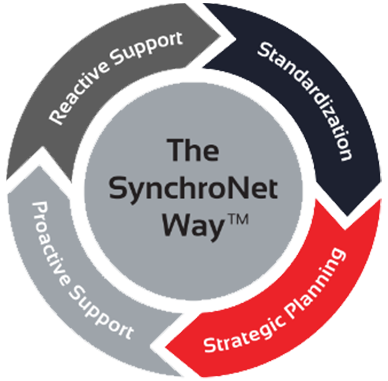
Want to move your business IT from the wild, wild West to an island of serenity? We get it, and we’ve helped transform everyday work life for hundreds of clients using The SynchroNet Way.
With our approach you get:
-
Standardization and a 100-point Best Practices checklist assigned to a dedicated network administrator.
-
Strategic planning at an executive level with a dedicated vCIO that keeps you on track for the long run.
-
Proactive support that monitors and protects your systems around the clock.
-
Reactive support from our friendly and caring customer support team who are always on the lookout for repeat issues.

Don't Gamble With Your Cybersecurity

Going without cybersecurity really isn’t an option anymore. If you fail to secure your digital assets you risk data breaches, financial loss, disrupted operations and damage to your reputation.
Why live with these risks? Let SynchroNet protect your business and ensure your resilience in the digital age.
FAQs
Ransomware Protection is a layered set of cybersecurity controls designed to prevent, detect and recover from attacks that encrypt your business data and demand payment for restoration. Modern ransomware attacks target operational downtime, not just data, making ransomware protection an important part of business continuity and cybersecurity planning.
Core ransomware protection controls:
- Immutable backup and recovery: Immutable backups cannot be altered or deleted, even by an attacker with admin credentials, helping businesses recover data without paying a ransom.
- Endpoint Detection and Response (EDR): EDR software continuously monitors endpoint activity and identifies suspicious behavior, such as unauthorized encryption or unusual file activity, before an attack spreads.
- Patch management: Security updates help close known software vulnerabilities. If critical patches are delayed, then attackers may exploit those weaknesses to gain access to business systems.
- Phishing awareness training: Email phishing is the most common ransomware delivery method. Staff training reduces the risk that a single click opens the door to a network-wide attack.
- Multi-factor authentication (MFA): MFA and access controls help prevent unauthorized access to email, cloud platforms and remote access tools, which are common ransomware entry points.
To understand how ransomware enters a network, visit our Ransomware Protection page or read our answer to this related question: How does ransomware usually get into a business network?
Ransomware Protection starts with understanding entry points. Most ransomware attacks start through compromised credentials, phishing emails, unpatched software or unsecured remote access tools rather than direct attacks on well-maintained network infrastructure.
Common ransomware entry methods:
- Phishing emails: Fraudulent messages attempt to trick users into clicking malicious links or opening infected attachments. One click from one employee can deploy ransomware across an entire network.
- Stolen credentials: Reused, weak or compromised passwords allow attackers to access email, VPN and cloud systems while appearing to be legitimate users.
- Unpatched vulnerabilities: Outdated software and operating systems often contain known security flaws that attackers can identify and exploit.
- Remote Desktop Protocol (RDP) exposure: Poorly secured RDP services can provide a direct path into business systems. If RDP is exposed to the internet without MFA protection, attackers may attempt to gain unauthorized access through automated attacks.
- Supply chain compromise: Trusted vendors and third-party tools can be leveraged to introduce malware into internal systems and bypass perimeter defenses entirely.
To understand how to respond if an attack occurs, visit our Ransomware Protection page or read our answer to this related question: What should a Buffalo business do if they are hit by ransomware?
Ransomware Protection planning helps businesses respond quickly and recover more effectively after an attack. A Buffalo business affected by ransomware should immediately isolate impacted systems, activate its incident response plan and engage cybersecurity professionals to contain the threat and begin recovery efforts. Every minute of delay allows the ransomware to spread to additional systems.
Ransomware response steps include:
- Network isolation: Disconnect infected devices (wired and wireless) from the network immediately to stop the ransomware encryption process from spreading to other systems and file shares.
- Incident response activation: Engage your IT or cybersecurity team to assess the scope of the attack, identify affected systems and determine the appropriate recovery strategy.
- Backup restoration: Restore systems from clean, immutable backups that were not connected to the infected environment. If backups are not immutable, attackers may have already encrypted or deleted them.
- Credential reset: Change administrative and user passwords across affected systems, including cloud applications and remote access tools, before reconnecting restored devices to the network.
- Forensic analysis: Identify the entry point and the attack timeline to help close security gaps and reduce the risk of future incidents.
To build a prevention strategy before an attack occurs, visit our Ransomware Protection page or read our answer to this related question: What is ransomware protection and why is it essential for businesses?