The Invisible Margin Killer: How Poor IT Infrastructure in Construction Quietly Erodes Your Project Profits

For construction firms in Western New York, every dollar is tracked: materials, fuel and labor. But there’s a hidden drain on your margins that doesn’t show up on a spreadsheet: your construction IT infrastructure.

Slow systems, disconnected tools and outdated setups create constant friction across your job sites. And this friction doesn’t show up as a single expense—it compounds daily as crews are delayed, mistakes are more frequent and sensitive data is exposed.

At SynchroNet, we call this the “Legacy Tax.”  For many firms, failing to prioritize IT for construction is quietly eating away at the profitability of every job in the pipeline.

Key Takeaways

  1. Small IT delays compound into significant labor cost losses across active job sites.
  2. Poor version control and disconnected systems increase rework risk, turning profitable projects into break-even jobs.
  3. Unsecured file sharing and subcontractor access gaps expose sensitive data and create avoidable business risk.

Why Poor Construction IT Infrastructure Acts as a “Legacy Tax”

In an industry where margins are razor-thin, your digital backbone is just as critical as your physical equipment. When your construction IT solutions are reactive rather than strategic, you aren’t just dealing with “tech issues”—you are paying a recurring tax on your efficiency.

4 Ways Inefficient IT for Construction Drains Your Budget

1. The “Spinning Wheel” Stoppage

When crews can’t quickly access the drawings or files they need to do their jobs, work slows—and sometimes stops.

A few minutes of delay doesn’t sound like much until it affects an entire team every day and begins to compound. For example, if a 15-person crew loses just 15 minutes a day to slow systems, that can translate into hundreds of lost labor hours over the course of a project.

High-performance teams shouldn’t have to idle waiting for IT to catch up, yet many construction firms find themselves in this position with no clear solution.

2. The Re-Work Trap

One of the leading causes of rework is ineffective document version control. It’s common for construction teams to accidentally work from different versions of the same document, sometimes even missing critical revisions.

This leads to costly mistakes, rebuilds and sometimes disputes. What should have been a profitable build quickly loses margin. In many cases, these mistakes aren’t just delays—they directly eat into your profit or force you to absorb unexpected costs.

Luckily, while rework is a costly and frustrating issue, it is also preventable with the right controls in place.

3. The Subcontractor Security Gap

Most construction IT setups treat subcontractors like internal employees so that they can get access to what they need for work. But granting access to your systems doesn’t just give them what they need It also allows them to access sensitive data. In some cases, that can include bid information or internal project details that give others unintended visibility into your business.

Allowing entry to your systems without access control is not only inefficient—it’s a serious business risk.

4. Shadow IT

When systems are slow or difficult to use, employees find workarounds. Shadow IT is a problem in every industry, but construction companies face unique risks.

When employees start sharing information through personal accounts or communication channels, your data moves outside your environment—where it is no longer controlled or secure. This can also create issues with compliance requirements, especially for firms working on municipal or government-funded projects.

Furthermore, if an employee unknowingly uses a compromised platform, your data is exposed to cyber threats and further risk.

When systems are slow, employees look for faster ways to work—like texting large files instead of uploading them. These quick fixes are meant to help, but they leave your data exposed and your entire company at risk.

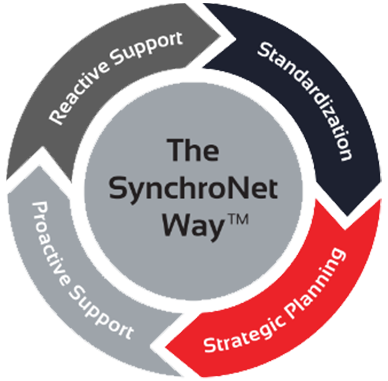
The SynchroNet Way: Managed IT for Construction Firms

Your infrastructure shouldn’t be working against you. With the right strategy, it can shift from being a silent margin killer to an operational advantage.

Construction operates in bursts—tight deadlines, shifting crews and constant coordination between the field and office. Your systems need to keep up.

With SynchroNet managed IT for construction, infrastructure includes:

  • Reliable construction IT solutions that provide field access to BIM and CAD files in seconds.
  • Real-time synchronization so every team works from the latest version.
  • Offline capability to keep crews productive in low-connectivity environments.
  • Granular access controls so subcontractors only have access to what they need.
  • Powerful cloud infrastructure that eliminates the need for workarounds.

This means your teams can work faster, collaborate more effectively and avoid the common breakdowns that slow projects down.

Your Construction IT Checklist

Most companies don’t realize how much their infrastructure is costing them until they stop and evaluate it. If you can’t confidently check these boxes, your infrastructure is likely costing you money:

  • Can field crews access updated drawings in seconds (not minutes)?
  • Do you have a single source of truth for all project files?
  • Do you have strict access controls so employees and subcontractors only see what they need?
  • Can work continue even when connectivity drops?
  • Can lost or stolen devices be locked or wiped immediately?
  • Is your cloud supporting efficient collaboration, sharing and communication?
  • Is your client and sensitive data secure?
  • Are you familiar with IT compliance requirements?

Sync Up Your Job Site

Every delay, every workaround and every mistake tied to slow or outdated systems adds up. What feels like a minor inconvenience in the moment can quietly cost your company thousands over the course of a project.

SynchroNet helps construction firms identify where that loss is happening and fix it with infrastructure built for how your teams actually work. We understand the unique challenges of the Western New York landscape—from maintaining connectivity in rural job sites outside of Rochester to securing the data of Buffalo’s growing infrastructure projects.

Book a meeting to see where your IT is costing you time and money—and how to take it back.

Jerry Sheehan

Jerry Sheehan

SynchroNet CEO Jerry Sheehan, a Buffalo, NY native and Canisius University graduate with a Bachelor's in Management Information Systems, has been a prominent figure in the IT business world since 1998. His passion lies in helping individuals and organizations enhance their productivity and effectiveness, finding excitement in the challenges and changes that each day brings. Jerry’s commitment to making people and businesses better fuels his continued success and enthusiasm in his field!

Are Your Cybersecurity Essentials Covered?

Don't wait until a threat strikes to protect your organization from cybersecurity breaches. Download our free cybersecurity essentials checklist and take the first step toward securing your digital assets.

With up-to-date information and a strategic plan, you can rest assured that your cybersecurity essentials are covered.

Get the Checklist