
-
Safeguard your business
-

Be protected against threats

-
Comply with industry regulations

Cybersecurity Services For Companies
-
Email Filtering
Protect your company’s inboxes from malicious emails and spam so only safe messages get through

-
MFA and 2FA
Multi-factor authentication and two-factor authentication prevent unauthorized access to your systems

-
Firewall Protection
Defend against unauthorized network access and cyber threats with robust firewall solutions
-
Phishing and Security Awareness Training
Equip your team with the knowledge to spot cyber threats and make security-conscious decisions

-
Malware and Antivirus Protection
Shield your systems with up-to-date, powerful protection solutions

-
Dark Web Scanning With Follow-Ups
Uncover potential breaches of your data and receive actionable insights to enhance your security posture

Is Inadequate Cyber Security Keeping You Up at Night?
- Do you struggle to keep up with ever-evolving cybersecurity challenges and feel overwhelmed?
- Are phishing attacks and data breaches a constant concern for your business?
- Is the dark web a mystery you wish you could unravel to protect your digital assets?
We get it: You want to stop worrying over cybersecurity challenges and uncertainties.
Business Cybersecurity: Your Trusted Guide
At SynchroNet, we understand the complexities of cybersecurity, and we're here to be your trusted guide. We offer expert guidance to help you make informed decisions, stay one step ahead of threats, and fortify your defenses.
Partner with us for a more secure digital future.
-
Repeat IT issues cut by 60 percent after 3 - 6 months
-
60-day “no questions asked” refund policy
-
80 + businesses trust SynchroNet for IT services

SynchroNet Customers Say




The SynchroNet Way
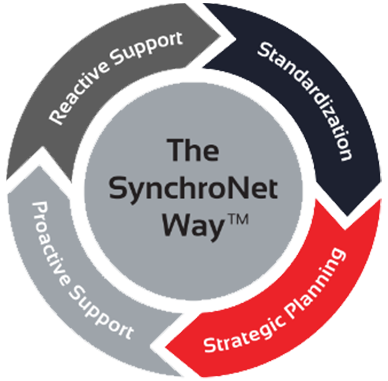
Want to move your business IT from the wild, wild West to an island of serenity? We get it, and we’ve helped transform everyday work life for hundreds of clients using The SynchroNet Way.
With our approach you get:
-
Standardization and a 100-point Best Practices checklist assigned to a dedicated network administrator.
-
Strategic planning at an executive level with a dedicated vCIO that keeps you on track for the long run.
-
Proactive support that monitors and protects your systems around the clock.
-
Reactive support from our friendly and caring customer support team who are always on the lookout for repeat issues.

The Cost of Not Using Cyber Security Firms

What’s at stake without robust cybersecurity measures? Neglecting cybersecurity can put you at risk of data breaches, financial loss and operational disfunction.
Every business, no matter its size, is a potential target.
Let SynchroNet guide you in embracing robust cybersecurity to protect your organization.



FAQs
Cybersecurity is the practice of protecting your systems, networks and digital assets from cyber threats that attempt to access, change or destroy sensitive business information. Cybersecurity for Companies is essential for Western New York businesses because it safeguards sensitive data, prevents financial loss and maintains business reputation while supporting the continuous operation of core digital infrastructure.
Core cybersecurity protection services include:
- Network security: Firewalls, intrusion prevention systems and segmentation controls protect business networks from unauthorized access and lateral movement between systems.
- Threat detection and response: Security monitoring tools identify suspicious activity in real time and trigger rapid response to contain potential incidents before escalation.
- Vulnerability assessments: Regular scanning of systems, applications and endpoints identifies unpatched software, misconfigurations and exploitable weaknesses before attackers can use them.
- Data protection: Encryption standards such as AES-256 protect data at rest and in transit, reducing exposure in the event of an interception or breach.
- Employee security training: Structured training programs reduce risk from phishing, credential theft and social engineering by improving user-level security awareness.
To learn more, visit our Cybersecurity for Companies page or read this related FAQ: What are the most common cyber threats facing Pennsylvania and New York SMBs today?
Common cyber threats affecting Pennsylvania and New York SMBs include phishing attacks, credential theft and “Living off the Land” (LotL) techniques that abuse legitimate system tools. These threats target employee access, business credentials and internal systems to disrupt operations, steal data or enable unauthorized financial transactions.
Cyber threat categories impacting SMB environments include:
- Phishing attacks: Fraudulent emails impersonate trusted vendors, executives or financial institutions to trick employees into revealing passwords, approving payments or downloading malicious attachments.
- Credential theft and harvesting: Attackers use stolen or reused passwords from data breaches to gain unauthorized access to email systems, cloud platforms and business applications.
- Living off the Land (LotL) attacks: Adversaries use legitimate tools such as PowerShell, Windows Management Instrumentation (WMI) and remote administration utilities to avoid detection by traditional antivirus systems.
- Business email compromise (BEC): Attackers infiltrate or spoof executive email accounts to redirect payments or manipulate internal financial approvals.
To learn more, visit our Cybersecurity for Companies page or read this related FAQ: How does a cybersecurity firm’s approach differ from basic antivirus software?
A cybersecurity firm’s approach differs from basic antivirus software by using identity-based, behavior-driven protection instead of relying on signature-based detection. Cybersecurity for Companies requires real-time monitoring to identify threats that do not match known malware patterns. This approach reduces blind spots created by traditional antivirus tools and strengthens overall attack surface protection.
Cybersecurity approach differences include:
- Endpoint Detection and Response (EDR): EDR tools monitor endpoints continuously for suspicious behavior such as unusual login patterns, unauthorized data access or abnormal process execution, enabling faster detection than signature-based antivirus tools.
- Identity-first Zero Trust security: Zero Trust models verify every user and device continuously instead of trusting internal network access by default, reducing the risk of lateral movement after credential compromise.
- Behavior-based threat detection: If a user account begins downloading large volumes of sensitive data at unusual hours, automated alerts trigger immediate investigation before data exfiltration occurs.
- Attack surface management: Cybersecurity firms protect the full attack surface, including endpoints, identities, applications and cloud systems, rather than only scanning files for known malware signatures.
- Multi-layered defense strategy: Firewalls, MFA (multi-factor authentication), email filtering and security awareness training work together to reduce exposure across multiple entry points rather than relying on a single antivirus layer.
To learn more, visit our Cybersecurity for Companies page or read this related FAQ: What are the most common cyber threats facing Pennsylvania and New York SMBs today?
A cyber security firm or MSP can provide expertise, tools and services to safeguard your company against cyber threats. They assess vulnerabilities, create customized security solutions and offer ongoing monitoring to proactively defend your digital assets. Their expertise ensures that your business remains protected and compliant with security regulations.
Cybersecurity firms offer a wide range of services, including network security, threat detection and response, vulnerability assessments, data protection and employee training. These services are designed to create a multi-layered defense strategy to prevent cyberattacks and minimize risks.
When selecting a cyber security firm, consider factors such as their experience, industry reputation, service offerings, scalability, compliance expertise and response time. Choose a firm that aligns with your business needs and can provide the level of security and support that suits your unique requirements.
Ransomware Protection is a layered set of cybersecurity controls designed to prevent, detect and recover from attacks that encrypt your business data and demand payment for restoration. Modern ransomware attacks target operational downtime, not just data, making ransomware protection an important part of business continuity and cybersecurity planning.
Core ransomware protection controls:
- Immutable backup and recovery: Immutable backups cannot be altered or deleted, even by an attacker with admin credentials, helping businesses recover data without paying a ransom.
- Endpoint Detection and Response (EDR): EDR software continuously monitors endpoint activity and identifies suspicious behavior, such as unauthorized encryption or unusual file activity, before an attack spreads.
- Patch management: Security updates help close known software vulnerabilities. If critical patches are delayed, then attackers may exploit those weaknesses to gain access to business systems.
- Phishing awareness training: Email phishing is the most common ransomware delivery method. Staff training reduces the risk that a single click opens the door to a network-wide attack.
- Multi-factor authentication (MFA): MFA and access controls help prevent unauthorized access to email, cloud platforms and remote access tools, which are common ransomware entry points.
To understand how ransomware enters a network, visit our Ransomware Protection page or read our answer to this related question: How does ransomware usually get into a business network?
Ransomware Protection starts with understanding entry points. Most ransomware attacks start through compromised credentials, phishing emails, unpatched software or unsecured remote access tools rather than direct attacks on well-maintained network infrastructure.
Common ransomware entry methods:
- Phishing emails: Fraudulent messages attempt to trick users into clicking malicious links or opening infected attachments. One click from one employee can deploy ransomware across an entire network.
- Stolen credentials: Reused, weak or compromised passwords allow attackers to access email, VPN and cloud systems while appearing to be legitimate users.
- Unpatched vulnerabilities: Outdated software and operating systems often contain known security flaws that attackers can identify and exploit.
- Remote Desktop Protocol (RDP) exposure: Poorly secured RDP services can provide a direct path into business systems. If RDP is exposed to the internet without MFA protection, attackers may attempt to gain unauthorized access through automated attacks.
- Supply chain compromise: Trusted vendors and third-party tools can be leveraged to introduce malware into internal systems and bypass perimeter defenses entirely.
To understand how to respond if an attack occurs, visit our Ransomware Protection page or read our answer to this related question: What should a Buffalo business do if they are hit by ransomware?
Ransomware Protection planning helps businesses respond quickly and recover more effectively after an attack. A Buffalo business affected by ransomware should immediately isolate impacted systems, activate its incident response plan and engage cybersecurity professionals to contain the threat and begin recovery efforts. Every minute of delay allows the ransomware to spread to additional systems.
Ransomware response steps include:
- Network isolation: Disconnect infected devices (wired and wireless) from the network immediately to stop the ransomware encryption process from spreading to other systems and file shares.
- Incident response activation: Engage your IT or cybersecurity team to assess the scope of the attack, identify affected systems and determine the appropriate recovery strategy.
- Backup restoration: Restore systems from clean, immutable backups that were not connected to the infected environment. If backups are not immutable, attackers may have already encrypted or deleted them.
- Credential reset: Change administrative and user passwords across affected systems, including cloud applications and remote access tools, before reconnecting restored devices to the network.
- Forensic analysis: Identify the entry point and the attack timeline to help close security gaps and reduce the risk of future incidents.
To build a prevention strategy before an attack occurs, visit our Ransomware Protection page or read our answer to this related question: What is ransomware protection and why is it essential for businesses?